
If you’ve been wondering how to dress feminine without looking childish, you’re not alone. Modern feminine style is about more than pink dresses and frills; it’s about choosing clothing that feels elegant, sensual, and timeless. In this guide, you’ll discover feminine style tips that help you look and feel your best, without sacrificing comfort or authenticity.
In an age where sweatshirts and sweatpants dominate fast fashion vitrines (and, let’s be honest, more than half of what people wear on a daily basis), we’ve arrived at a curious moment in fashion history: one where “comfort” has been taken in its most literal, uninspired sense.
Just like a baby clings to a blanket or wriggles into a fleece onesie, many adults now dress not with intention, but with the urgency of staying warm, soft, and safely unnoticeable. On the opposite end of the spectrum, the idea of dressing feminine has been reduced to overly revealing, brightly colored dresses that teeter between costume and caricature.
Given today’s approach to fashion, learning how to dress feminine without feeling like a doll or an overgrown toddler is the ultimate style challenge. We’re caught between looking invisible in glorified pajamas or entirely absurd in flashy, infantile silhouettes.
But if you’ve landed on this article, you are not most people. You belong to the rare one percent of discerning women seeking something more refined. And I deeply respect that. In the pages ahead, we’ll explore timeless feminine style tips to help you dress in a way that feels feminine, elegant, and utterly your own. No corporate dresses, and no designer handbag required.
Why Feminine Style Feels So Confusing Today
Isn’t it ironic that companies will do anything to sell us femininity, when this energy already lives inside us, at our core? Somewhere along the way, we were taught to prioritize productivity, to live in our heads, and to lead with action. We were conditioned to operate from a masculine mode for so long that many of us forgot how to simply be. We lost touch with the feminine not because it disappeared, but because it was buried beneath the pressure to perform.
And yet, when femininity is sold back to us, it’s often done in such an extreme, distorted way. It’s reduced to something ornamental or childish, overly sexualized, fragile, and easily mocked. The feminine becomes a costume, a joke, or a commodity. But true feminine style doesn’t need to be shouted or wrapped in glitter and bows.
For me, dressing feminine is a form of sovereignty. It’s a way of returning to my body, to a sense of sensuality and self-expression that feels grown, grounded, and clear. In a world where sweatpants and oversized hoodies pass for fashion, choosing feminine clothing with softness and elegance is a form of inner alignment. It makes me feel like I have my life together without tipping into the overworked, overstructured masculine energy we’re so often praised for.
In fact, dressing this way protects me from falling into that push. It reminds me I don’t have to carry heavy boxes or speed-walk through life just to prove I’m capable. And honestly, have you ever felt like powerwalking in a silk slip or lugging furniture in a fitted skirt? Probably not. Dressing femininely is my reminder to slow down, while still allowing me to complete the daily tasks I set for myself.
My point is, the cultural confusion around femininity has only pulled us further away from our natural rhythm. But clothing can help us remember. When we dress in a way that honors her, we make space for the feminine to reawaken – not as something to display, but as something to live from.
Key Principles for Dressing Feminine and Elegant
Choose elegance, not excess
You’ll come to notice, on your quest to rediscover your femininity, that elegance is subtle. It is never about excess or sparkle.
Dressing feminine takes on a completely different dimension once you begin tuning in to your senses. Every fabric, object, jewel, or makeup product has the power to either seduce your senses or overwhelm them entirely.
A woman who dresses with elegance is attuned to the details: the way fabric moves, how a colour softens her skin, the shimmer of a jewel in soft light. She notices how her senses are stirred, and she chooses pieces that enhance that feeling.
A child, on the other hand, does not have this awareness. For her, everything must be exaggerated to be noticed: bright colours, heavy sparkle, oversized bows. This is why “cute” often leans toward the overly sweet or theatrical.
My personal rule of thumb is to replace the word “cute” with “sensual.” Anything that feels merely “cute,” I either avoid or transform into something sensual and subtle. And by sensual, I do not mean sexual, but something that invites softness, depth, and allure without shouting.
Let your fabrics speak
When exploring feminine outfit ideas, it is no surprise that the fabrics we choose can influence how feminine we feel. Dressing in a way that is both feminine and elegant begins with understanding fabrics.
This topic has been discussed widely online in recent years, as people have become more aware of the decline in quality offered by fast fashion, and how quickly garments now tear, pill, or lose their shape.
When it comes to fabric choice, my rule is simple: I ensure that the majority of my clothing is made from natural fibres. Polyester is sometimes unavoidable, especially in certain eveningwear that requires shaping, or in structured garments like blazers. And if I find a particular piece I love (one that feels beautiful on the body, aligns with my style, and happens to be synthetic) I will still wear it. But for my everyday wardrobe, I aim for about 80 percent natural fabrics, so that my clothes move with me, breathe with me, and feel soft and comfortable against my skin. Comfortable, however, does not mean sweatshirt-comfortable. It means refined, breathable, and alive.
Over time, I have noticed that a store’s creative direction and target audience often determine whether its garments are made from mostly natural or mostly synthetic materials. For instance, I know I can usually find quality natural fibres for most of the items at Club Monaco within a reasonable price range, while I do not expect the same from Zara. Even if a garment from a lower-cost retailer is labeled as a natural fibre, the quality is often noticeably different. Of course, there are many grades of silk, cashmere, wool, and cotton, and not all natural fibres are created equal.
Still, I enter a store with a clear expectation: is this brand selling quality, lasting materials, or chasing inexpensive trends? And I adjust accordingly. I can still buy a synthetic dress from Zara if it feels feminine, sensual, and good on my body so long as it is not overly revealing, remains timeless, works within my colour palette, and brings me that confidence I look for in my wardrobe.
When we picture elegant, feminine clothing, it is often associated with discomfort. Compared to sweatpants or casual wear, it may indeed feel less forgiving. But the difference lies in the fabric, and, most importantly, in the construction of the garment and how precisely it is tailored to your body, which brings us to our next point.
Reveal structure, not stiffness
I can’t help but feel both sad and slightly uncomfortable when I see a woman wearing something far too small or tight for her, especially when she clearly feels constricted by it. I love a well-tailored garment with structure, corsetry construction included, but it should always be altered to fit a woman’s current shape and size. That is, after all, what “tailored” truly means.
There is little point in appearing feminine and elegant if you are constantly rearranging your hem, tugging at a dress that rides up as you walk, or adjusting the bodice so it doesn’t cling awkwardly to your stomach when you sit down. These small but significant issues can all be resolved by a skilled alteration service.
A big part of dressing feminine is feeling at ease and confident in your body, combined with wearing clothing that is tailored to you. One cannot go without the other. You should be able to walk naturally, move with freedom, breathe fully, and live in your clothes, rather than feel confined by them. If you find yourself hesitating to buy a larger size for the sake of comfort, and feeling self-conscious or unworthy because of the number on the label, remember that no one else sees it. It is only a number. Sizes vary widely from brand to brand, and I much prefer choosing the size that allows me to feel entirely at ease, and having it tailored if needed, rather than buying something smaller and letting it sit unworn because it is uncomfortable and serves only as a reminder of weight I think I should lose.
Balance exposure with mystery
Femininity can be seductive or serene. It is yours to choose.
One of my favorite games in dressing is playing with how revealing or unrevealing an outfit can be. I tend to lean slightly toward the more conservative side, but always with a sensual twist. To me, the best way to balance exposure and maintain mystery is to cover the body generously, while allowing just enough detail to remind both myself and others of my femininity.
It might be a long, fluid maxi dress with a daring slit, or a similar dress with a low, graceful neckline. It could be a form-fitting dress softened by a structured blazer that conceals the full silhouette. Sometimes it is as simple as wearing a skirt to show the legs, paired with a modest kitten heel to create that subtle contrast between mystery and allure.
Play with movement, not mimicry
Think of an actual doll: how stiff and crisp her clothes usually are, how fixed her facial expression is, and how exaggerated her makeup, hair, heels, and nails can appear. Dressing feminine without feeling like a doll is about bringing movement into our outfits so that we look alive, dynamic, and present.
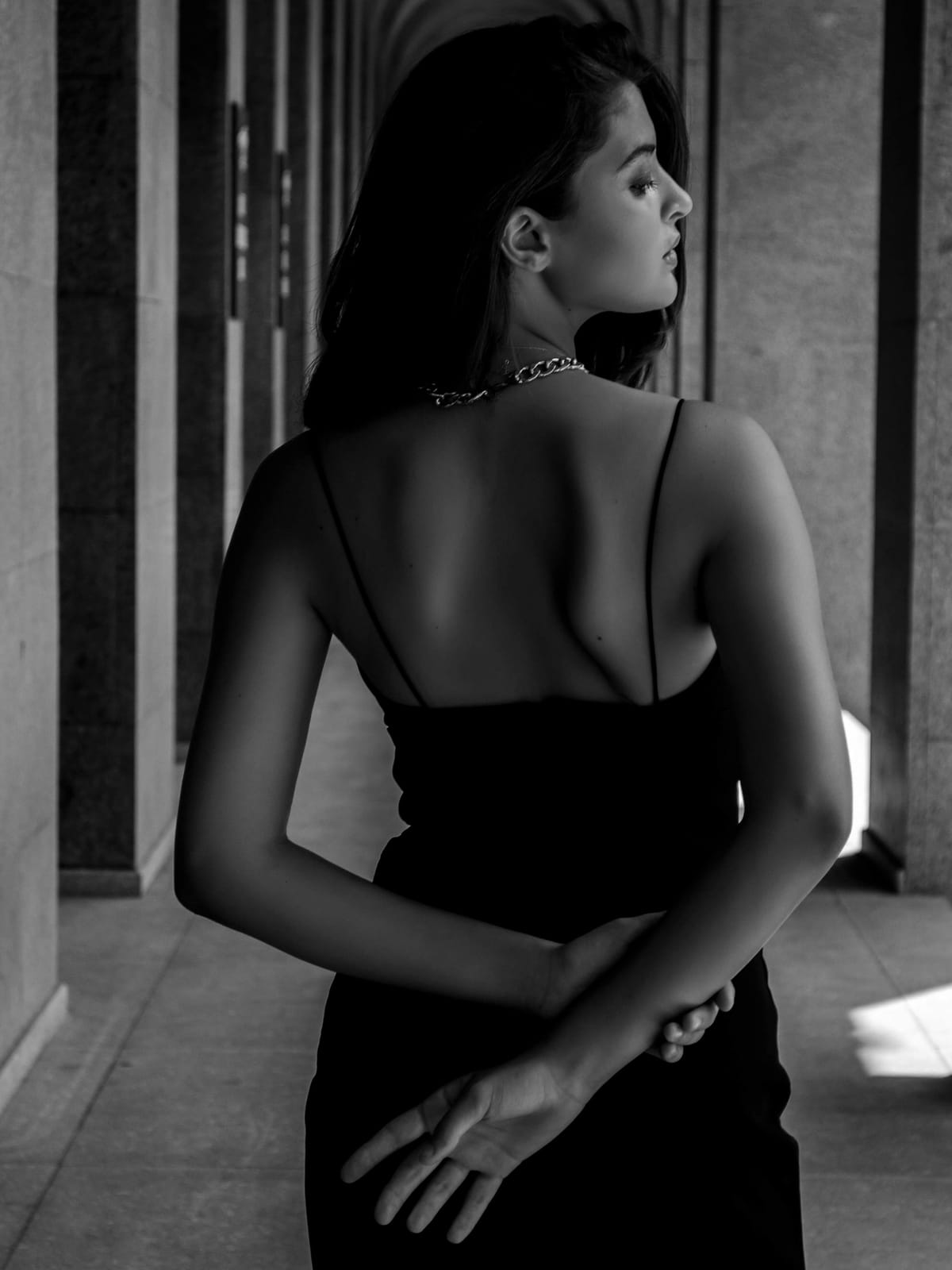
Now picture long coats, draped dresses with flowing sleeves, open backs. Fewer ruffles or tiny bows.
That said, as mentioned earlier, ruffles and bows can still have their place. If they lean toward the “cute” side, we can always adjust the overall styling so the look feels more sensual than girlie.
Final Thoughts
Dressing feminine without feeling like a doll is not about rejecting comfort or denying yourself beauty. It is about redefining what femininity feels like on your body and in your life. The fabrics you choose, the way a garment moves with you, the balance between allure and mystery; all of these are tools for self-expression rather than costumes to be worn for others.
True elegance comes from wearing what allows you to breathe, move, and feel at ease while still honouring your sensuality. It is found in the way a silk dress drapes over your skin, how a tailored jacket frames your posture, or how the right pair of heels can slow your steps just enough to make you feel present.
In the end, dressing feminine is not a performance. It is a daily choice to inhabit your body with confidence and grace, to honour the woman you are today, and to make space for the power of the feminine to guide how you walk through the world.
Frequently Asked Questions
Can you dress feminine without wearing pink?
Absolutely. Any colour that brings you joy, confidence, and a sense of being sensual and embodied can help you express femininity. From there, it becomes a matter of choosing the right undertone, value (light or dark), and chroma (bright vs muted) according to your colour palette so the shade enhances your presence rather than dulling it.
What are some feminine outfits that don’t feel childish?
Some of my favourites include dresses with midi or maxi hems, pieces with a defined waist, necklines that reveal just enough, and a classic kitten heel. These details create femininity without tipping into anything overly girlish.
How do I look feminine without wearing dresses?
I will admit that dresses are my personal go-to for feeling feminine. However, if I do wear trousers, I love a slim or gently flared style paired with a small heel. Although I personally do not wear jeans, a high-quality skinny jean with an elegant heel can also create a feminine look without relying on dresses.
Is femininity only about softness?
Not at all. While softness can be an aspect of femininity, it is not the only one. Femininity can also be powerful, structured, sensual, or serene. If softness is a natural part of who you are, then it will naturally shine through, but it is not the sole expression of feminine energy.
What fabrics feel most feminine and elegant?
Silk in all its forms (crêpe de chine, charmeuse, organza), cashmere, linen, and cotton, depending on the season. Lightweight fabrics often feel especially feminine in warmer months, while structured and heavier materials like a beautifully tailored wool coat can carry the same sense of elegance and refinement.